
10 Signs That Navy Veterans May Lose Their VA Disability Benefits

Receiving monthly compensation from the Department of Veterans Affairs brings peace of mind, but many former sailors assume these payments are permanent. The reality under 2026 regulations is that compensation remains vulnerable to reassessment unless specific legal thresholds are met. Whether dealing with spinal damage from heavy seas, flight deck hearing loss, or combat PTSD, sailors must understand how the VA monitors and re-evaluates disability claims.
Increase Your VA Disability Rating. Talk With An Expert. Free Call. Click HERE To See If You Qualify!
A reduction or termination of payments usually stems from either medical developments or administrative changes. To safeguard your earned benefits, let us break down the exact triggers across medical re-evaluations and post-discharge administrative requirements.
Recognizing the 10 Signs That Navy Veterans May Lose Their VA Disability Benefits in Medical Reviews
Medical monitoring is one of the most common pathways to a proposed rating reduction. The VA routinely tracks service-connected disabilities to verify if a condition is chronic or improving over time.
1. Missing a Scheduled Compensation & Pension (C&P) Re-Examination
Under 38 C.F.R. § 3.655, failing to report for a scheduled C&P re-examination without good cause gives the VA immediate authority to reduce or terminate your monthly compensation. When an active benefit is subject to re-evaluation and you miss the exam, the VA issues a pretermination notice. You have 60 days to respond or attend a rescheduled exam. If you miss your appointment due to hospitalization or an unavoidable emergency, contact the VA immediately to establish “good cause.” For a full breakdown of the evaluation process, consult the complete guide to VA disability claims.
2. Clear Evidence of Sustained Medical Improvement
If medical evidence reveals that your service-connected disability has significantly and permanently improved, the VA may initiate a rating reduction. However, a single good day or one anomalous medical exam is not enough. The VA is legally required to demonstrate sustained improvement across your full medical history under typical daily working conditions.
3. Filing a New Claim for an Increased Rating or Secondary Condition
Submitting paperwork for a condition increase or a secondary claim instructs the VA to pull your entire claims folder for review. If an adjudicator examines your records and discovers that another existing service-connected condition has improved, they can propose a reduction for that older rating. Before filing, review our VA disability rating increase guide 2026 to weigh your evidentiary strengths.
4. Having a 0% Non-Compensable Disability Rating
A 0% disability rating acknowledges a service-connected medical issue, but it does not provide monthly financial compensation. While it preserves your access to VA healthcare and prescription coverage for that issue, an unmonitored non-compensable condition will not pay out unless you file for an upgrade based on worsening symptoms or link secondary conditions to it. For example, over 82% of PACT Act-related claims for hypertension initially receive a 0% disability rating, which can be upgraded to 10% or higher if continuous medication is prescribed to control blood pressure.
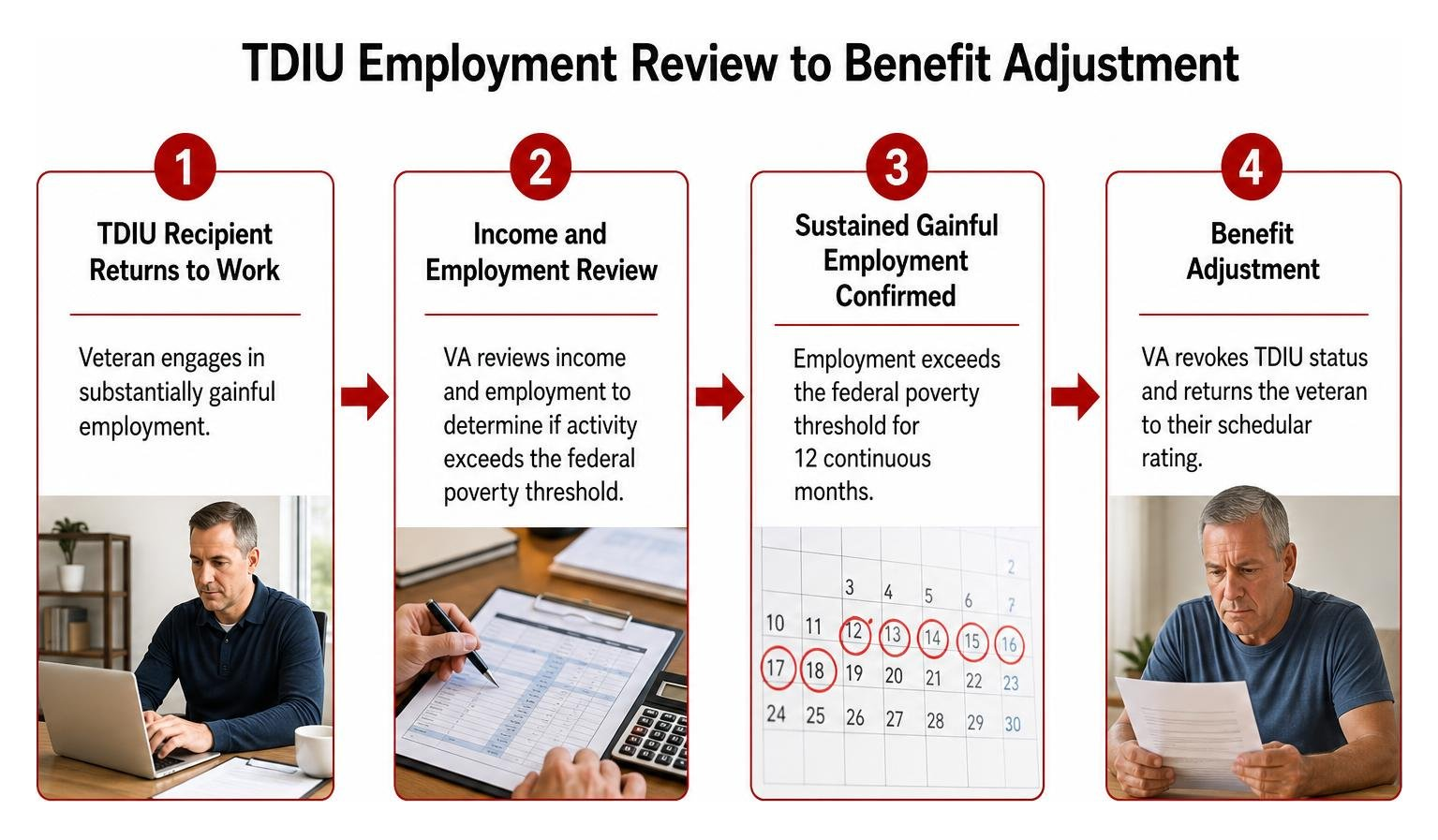
5. Exceeding TDIU Income Limits Through Substantially Gainful Employment
Total Disability based on Individual Unemployability (TDIU) pays veterans at the 100% disability rate because their service-connected disabilities prevent them from maintaining substantial gainful activity. If a Navy veteran receiving TDIU returns to work and sustains gainful employment exceeding the federal poverty threshold for 12 continuous months, the VA can revoke TDIU status and return the veteran to their schedular rating. Marginal employment (working part-time below poverty thresholds or in a protected family business) does not trigger this revocation.
Administrative 10 Signs That Navy Veterans May Lose Their VA Disability Benefits After Discharge
Administrative compliance and legal circumstances outside the clinic also dictate whether your payments continue uninterrupted.
6. Incarceration for a Felony Exceeding 60 Days
If a veteran is convicted of a felony and incarcerated for more than 60 days, federal statute mandates that monthly VA compensation be temporarily reduced starting on the 61st day. For veterans rated 20% or higher, monthly compensation is capped at the 10% disability payment rate. For veterans with a 10% rating, their monthly check is halved. Family members experiencing financial distress can file for an apportionment to redirect the withheld funds to dependents.
7. VA Recoupment of Separation Pay or Severance Bonuses
Federal law prohibits “double-dipping,” meaning a veteran cannot receive both military separation severance pay and VA disability compensation for the same period of service until that separation pay is fully repaid. The VA has collected $2.44 billion from 112,834 veterans since 2013 under this statute, recouping nearly $148 million from more than 9,000 former service members in the past year alone. Disability payments are withheld each month until the full pre-tax separation bonus is recovered.
8. Failure to Report Changes in Dependency Status
Veterans rated at 30% or higher receive additional monthly cash allowances for qualifying dependents, such as spouses, dependent parents, and minor children. If you fail to notify the VA of a divorce, a spouse’s passing, or a child turning 18 (and not enrolled in full-time education), the VA will calculate an overpayment debt once discovered and garnish future disability checks until repaid. Learn how to maintain your VA disability rating in 5 easy to follow steps to prevent administrative payment errors.
9. Clear and Unmistakable Error (CUE) or Administrative Address Issues
If the VA determines that the original grant of service connection was based on a Clear and Unmistakable Error (CUE)—meaning the evidence at the time did not legally support the grant—the VA can sever service connection. Similarly, failing to update your residential address in the VA.gov portal can cause missed appointment letters, culminating in benefit suspensions.
10. Fraud or Intentional Misrepresentation
Under 38 U.S.C. § 6103, any veteran who knowingly submits false statements, forged medical documentation, or fraudulent claims forfeits all rights to VA disability compensation and healthcare benefits. Fraud investigations can also lead to federal prosecution, heavy financial restitution orders, and tax refund offsets.
Understanding Protected Rating Rules: 5-Year, 10-Year, and 20-Year Protections
Congress enacted statutory protected rating rules to prevent arbitrary reductions and provide long-term financial stability to disabled service members. As your rating ages, the evidentiary burden on the VA increases significantly.
| Protection Level | Time Threshold | Legal Protection Standard | Exceptions |
|---|---|---|---|
| 5-Year Rule | 5 years continuous at current rating | VA must show sustained, lasting improvement across complete medical history | Fraud, CUE |
| 10-Year Rule | 10 years continuous service connection | Service connection cannot be severed or broken | Fraud only |
| 20-Year Rule | 20 years continuous at specific rating percentage | Rating percentage cannot be reduced below established baseline | Fraud only |
The 5-Year Sustained Improvement Rule
Once a disability rating has been in effect at the same percentage level for five years or more, it enters stabilized status. The VA cannot reduce your rating based on a single exam showing temporary relief. Instead, adjudicators must show that your medical records demonstrate material, sustained improvement under the ordinary conditions of daily life. To discover how re-evaluations work under this rule, read everything you need to know about the 5-year rule for VA disability.
The 10-Year and 20-Year Continuous Protection Rules
The 10-year rule protects the foundational service connection itself. Once a condition has been service-connected for ten continuous years, the VA is legally barred from severing that connection unless the initial claim was granted through fraudulent misrepresentation.
The 20-year rule offers the ultimate level of protection. Once a specific rating percentage has been continuously in effect for twenty years, the VA cannot reduce that rating below the lowest level held during that two-decade window for any reason other than fraud. Compare your established ratings against the current payment schedules in our VA disability rating chart guide 2026.
Due Process Rights: How to Respond to a Proposed Rating Reduction
The VA cannot immediately cancel or lower your compensation check without warning. Federal due process guarantees that veterans receive advance written notification and distinct timelines to defend their ratings.

When the VA plans a reduction, it issues a Notice of Proposed Reduction outlining the medical evidence behind the decision. To understand the administrative steps involved, see our VA lowers disability rating complete guide.
The 30-Day Hearing and 60-Day Evidence Windows
Once the Notice of Proposed Reduction is issued, two critical deadlines begin:
- The 30-Day Hearing Request Window: If you formally request a predetermination hearing within 30 days of the notice date, the VA must freeze your disability benefits at their current payment rate while you await the hearing.
- The 60-Day Evidence Window: You have 60 days from the notice date to gather and submit counter-evidence, including independent medical opinions, private doctor records, and Nexus letters demonstrating that your disability remains unchanged or disabling.
Navigating Appeals and Supplemental Claims
If the VA issues a final rating decision reducing your benefits after the due process review, you still have options under the Appeals Modernization Act:
- Supplemental Claim: Submit new and relevant medical evidence demonstrating the persistence of your disability.
- Higher-Level Review (HLR): Request a senior adjudicator to review the existing evidence to see if the reduction violated procedural regulations.
- Board of Veterans’ Appeals (BVA): Take your case before a Veterans Law Judge for a formal ruling.
For actionable steps to overturn an adverse VA decision, read how to turn your VA denial into a winning appeal and verify baseline VA eligibility guidelines. To learn more about your statutory rights, visit Can My VA Disability Benefits Be Taken Away? and Can You Lose VA Disability Benefits? Rules and Protections – LegalClarity.
Frequently Asked Questions About VA Benefit Reductions
Can filing a claim for a secondary condition lower my current Navy disability rating?
Yes. When you submit a secondary claim or an increase request, you grant the VA permission to re-examine your entire claims folder. If medical records or new C&P examinations reveal sustained improvement in an older, non-protected condition, the VA can initiate a proposed reduction on that specific disability while evaluating your new claim.
What happens to my disability compensation if I receive Navy severance or separation pay?
Under federal law, the VA must withhold your monthly disability compensation until the total amount of gross separation or severance pay has been fully recouped. Proposed legislation, such as the Restore Veterans’ Compensation Act, seeks to end this dual-compensation recoupment policy, but full withholding remains the current statutory standard.
How does felony incarceration impact monthly VA disability payments?
Incarceration for a misdemeanor does not alter your benefits. However, if you are incarcerated for a felony for longer than 60 days, your payments are reduced starting on the 61st day. Veterans rated at 20% or higher are capped at the 10% payment rate, and veterans rated at 10% receive a 50% reduction. Dependents can apply for an apportionment of the withheld funds by demonstrating financial hardship.
Conclusion
Guarding your VA disability benefits requires vigilance, organized medical records, and quick action whenever the VA contacts you. Attend every scheduled C&P re-examination, update your contact and dependent records, and understand your statutory rights under the 5-, 10-, and 20-year rules.
If you are ready to file a new claim, explore dependency benefits, or manage an existing award, start by applying for VA disability benefits through our comprehensive guides. Explore our central resource hub at USMilitary.com for reliable military career, finance, and retirement support. For those navigating challenging life transitions after service, consider reading Dare to Live Greatly for practical guidance and inspiration.