
Why BUD/S Is Often Called the World’s Toughest Military Training
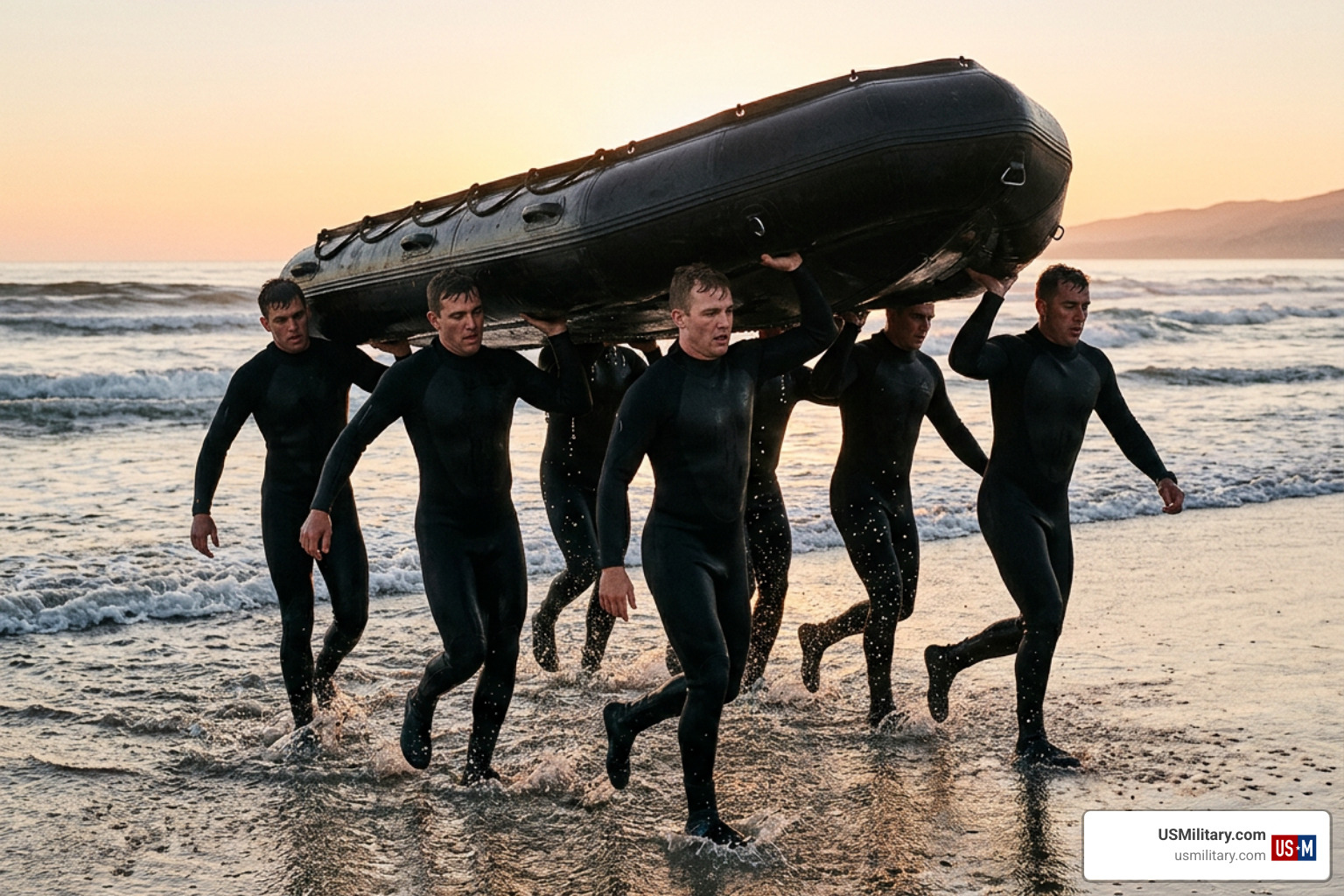
BUD/S is one of the toughest military training programs in the world, but no single course can be proven to be the toughest for every person. Its combination of cold ocean exposure, long-distance running, swimming, heavy team tasks, and extreme sleep loss makes it a leading contender – especially among entry-level special operations pipelines.
More Than 90% Of Clients Have Increased Ratings! Why Settle For Less Than You Deserve? Expert Priority Help With Your VA Claim Today! Free Evaluation Call!
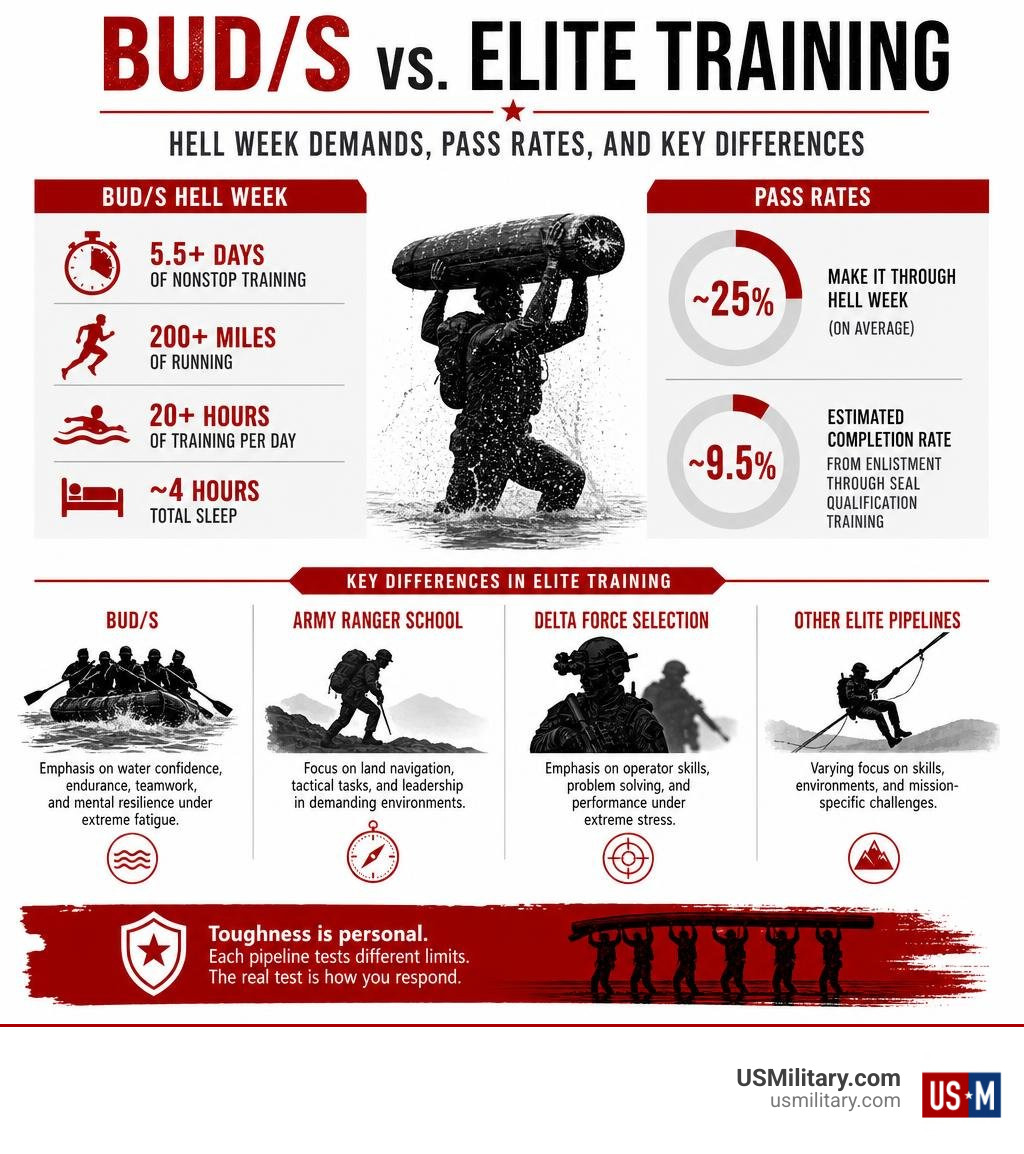
Hell Week is the best-known example. Over 5.5 days, candidates may train more than 20 hours per day, run more than 200 miles, and get no more than about four hours of total sleep. About 25% of candidates, on average, make it through Hell Week. Army Ranger School, Delta Force selection, and other elite programs test different forms of endurance, leadership, isolation, and stress, so the honest comparison depends on what “toughest” means.
BUD/S is not simply a fitness test. Candidates need exceptional endurance, strong water confidence, injury resistance, calm decision-making under fatigue, and the ability to keep working for their boat crew when they are cold, exhausted, and discouraged. The wider path from enlistment through SEAL Qualification Training has an estimated completion rate of about 9.5%.
I am Larry Fowler, publisher of the USMilitary.com Network since 2007, where I have helped active-duty members, veterans, and future service members make sense of military careers and benefits. In this guide to Is Navy SEAL BUD/S Training The Toughest Training In The World?, I will compare the facts behind BUD/S with other elite military pipelines.
Discover more about Is Navy SEAL BUD/S Training The Toughest Training In The World?:
- Navy SEALs BUD/S Training Requirements
- What is Navy SEAL Training 3 Phases And WHy is it so tough
- Who Has The Hardest Training: Navy SEALs vs Army Rangers
Understanding the Pipeline: What BUD/S Training Involves
To understand why Basic Underwater Demolition/SEAL (BUD/S) carries such legendary status, you have to look at the entire pipeline. Located at the Naval Special Warfare Center in Coronado, California, BUD/S is a 24-week selection course designed to assess whether candidates possess the physical resilience, psychological grit, and character required of maritime special operators.
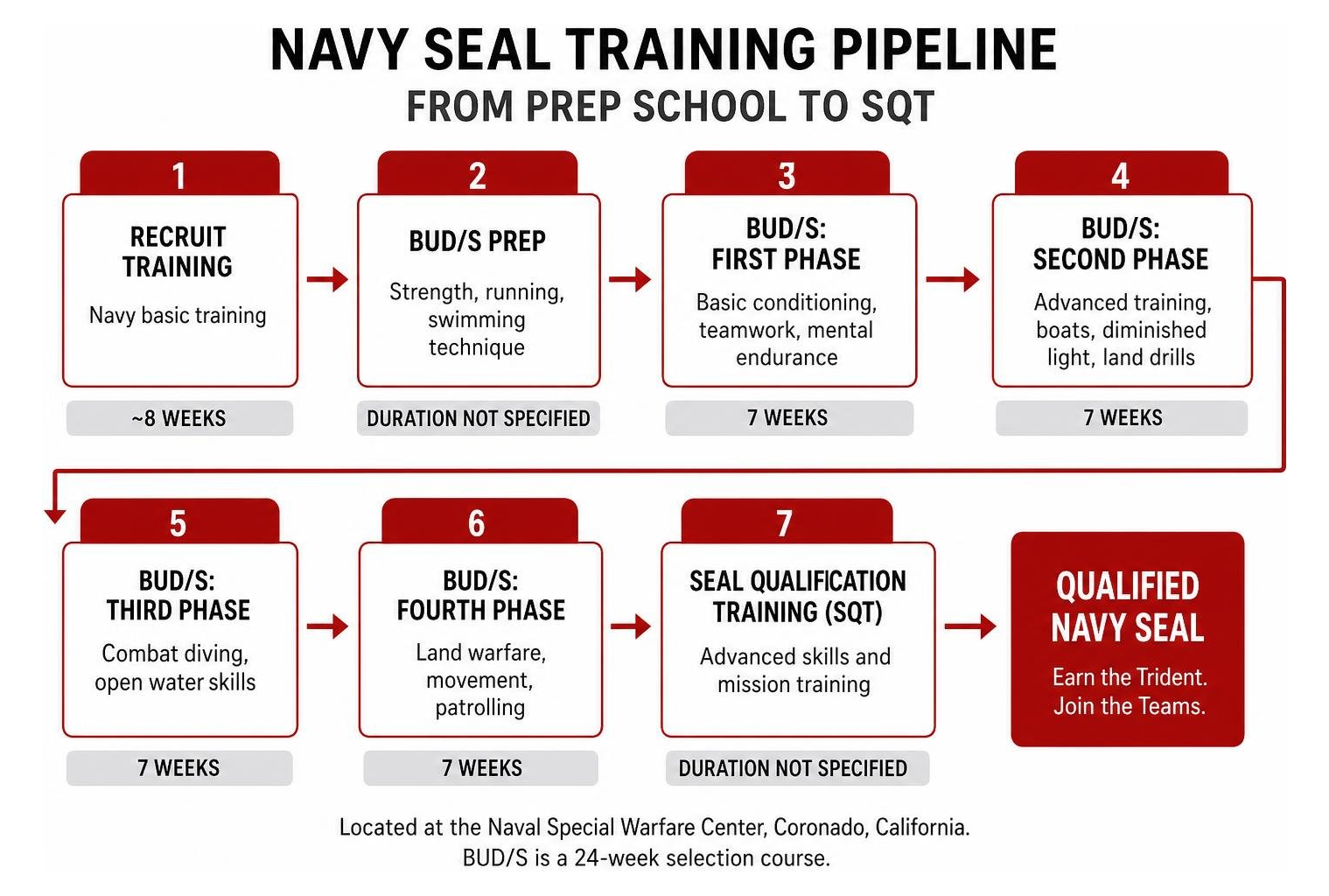
Before stepping onto the black asphalt grinder in Coronado, enlisted candidates attend Navy recruit training followed by an intensive preparatory course. At BUD/S Prep, recruits focus heavily on strength conditioning, running mileage, and swimming technique. Understanding how long is Navy SEAL training helps put the journey into perspective: from the initial enlistment contract through advanced instruction, candidates dedicate well over a year to earn their place in the teams. The structured curriculum spans across the 4 phases of Navy SEAL training, starting with orientation and moving through physical conditioning, combat diving, and land warfare.
First Phase and the Crucible of Hell Week
First Phase lasts seven weeks and focuses purely on basic conditioning, teamwork, and mental endurance. Candidates endure endless calisthenics on the grinder, two-mile ocean swims, timed four-mile timed runs on soft sand, and navigating the infamous Navy SEAL training obstacle course.
The defining milestone of First Phase—and perhaps all military selection programs—is Navy SEAL Hell Week. Taking place during the third week of Phase 1, Hell Week consists of 5.5 days of continuous physical exertion where candidates log over 200 miles of running and complete grueling evolutions while accumulating less than four hours of sleep total.
Events include:
- Log PT: Teams of six to eight sailors maneuver massive telegraph poles weighing several hundred pounds through repetitive overhead presses, lunges, and carries.
- Surf Torture (Cold Water Inoculation): Trainees lie linked arm-in-arm in the freezing Pacific surf zone until mild hypothermia sets in, testing their mental threshold.
- Around-the-Clock Boat Drills: Crews paddle inflatable combat raiding craft (IBS) through crashing ocean swells and carry the 150-pound craft on their heads everywhere they travel.
According to formal documentation on United States Navy SEAL selection and training, only about 33% of initial Phase 1 candidates advance past this conditioning block.
Combat Diving, Land Warfare, and SQT
Surviving Hell Week does not guarantee a Trident. Candidates who make it through the initial crucible advance to Second Phase (Combat Diving) and Third Phase (Land Warfare).
Second Phase turns the focus toward underwater competency, open-circuit scuba, and closed-circuit rebreathers. Students learn the intricacies of dive physics while undergoing high-stress pool competency drills, where instructors simulate underwater equipment malfunctions and entanglement. In Third Phase on San Clemente Island, students master weapons handling, marksmanship, small-unit tactics, land navigation, and demolitions.
Graduating BUD/S earns a sailor the right to attend the 26-week SEAL Qualification Training (SQT), followed by military free-fall HALO jump school and cold-weather survival. Only after completing SQT does a candidate officially receive the Special Warfare insignia (the Trident) and complete formal SEAL training.
Comparing the World’s Most Brutal Military Selections
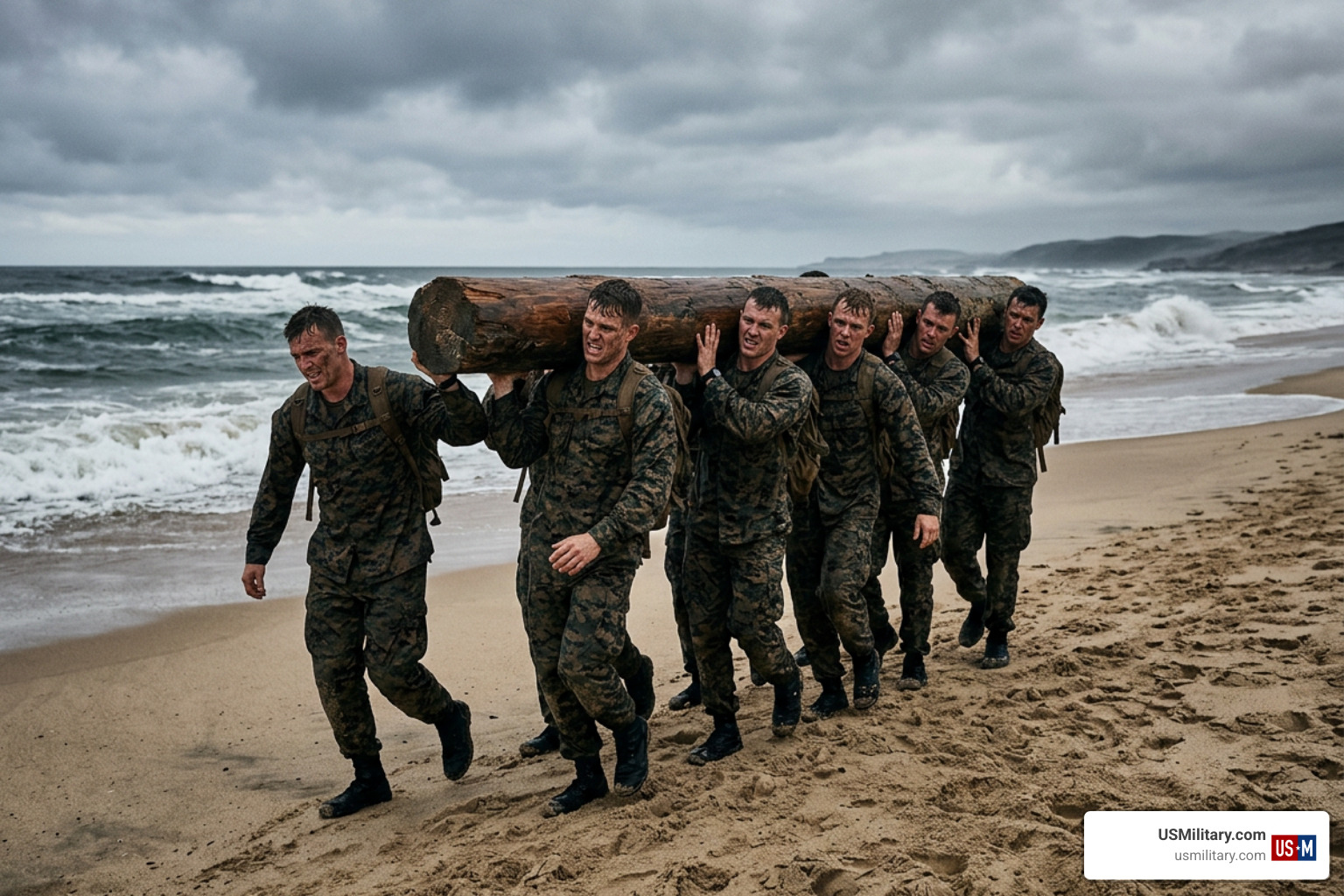
When people ask whether BUD/S is the hardest training program on the planet, they are usually comparing it against other celebrated elite schools. While every special operations pipeline is designed to push humans past their limits, each course evaluates different operational skill sets and psychological stressors.
| Program | Service Branch | Duration | Primary Focus | Sleep / Caloric Deprivation | Typical Attrition Rate |
|---|---|---|---|---|---|
| Navy SEAL BUD/S | U.S. Navy | 24 Weeks | Maritime operations, cold-water tolerance, ocean endurance | Extreme during Hell Week (<4 hrs over 5.5 days) | 70% – 80% |
| Army Ranger School | U.S. Army | 62 Days | Small-unit combat leadership, continuous field patrolling | Chronic, sustained sleep & caloric deficit | 50% – 60% |
| Delta Force Selection (A&S) | U.S. Army | ~4 Weeks | Solitary navigation, psychological self-reliance, covert direct action | High-endurance stress with psychological isolation | 85% – 90% |
| Marine Corps Boot Camp | U.S. Marines | 13 Weeks | Basic recruit transformation, rifle marksmanship, discipline | Structured, regulated training schedule | 10% – 15% |
For a foundational breakdown of basic entry courses versus elite pipelines, review Buds Vs. Marine Boot Camp: Which Military Training Is Tougher? outlines the stark differences between initial recruit training and special warfare selection.
BUD/S vs. Army Ranger School and Green Beret Training
The contrast between BUD/S and Army leadership courses is one of the most widely debated topics across the armed forces. Comparing Ranger School vs Navy SEAL training reveals distinct philosophies. Army Ranger School is a 62-day tactical leadership course broken into the Benning, Mountain, and Florida Swamp phases. Where BUD/S seeks to break individuals down through acute physiological shocks, hypothermia, and high-impact ocean physical training, Ranger School evaluates a soldier’s ability to lead tired, starving peers through continuous combat patrols under chronic caloric restriction.
Similarly, examining Navy SEAL vs Army Green Beret training shows differing operational endpoints. Green Beret candidates in the Special Forces Qualification Course (SFQC) spend upwards of a year to eighteen months mastering unconventional warfare, foreign languages, and cross-cultural communication in addition to direct-action tactics.
BUD/S vs. Delta Force Selection: Physical Grind vs. Psychological Isolation
Comparing BUD/S to Tier-1 screening pipelines involves looking at entirely different candidate pools. In our comparison of Navy SEAL vs Delta Force, recruitment dynamics play a major role. BUD/S accepts raw civilian recruits and filters out those who lack baseline physical durability. Delta Force Selection (Assessment and Selection) tests veteran soldiers who have already served years in the Rangers, Special Forces, or conventional combat arms.
Delta’s signature test, known as “The Long Walk,” is a 40-mile solitary land navigation trek through mountainous terrain with zero staff feedback or peer interaction. While BUD/S relies heavily on boat-crew synchronization and overt instructor pressure, Delta assesses an operator’s internal compass and solitary psychological determination. Candidates weighing these distinct selection paths can review the In Depth Guide to Navy SEAL BUD/S vs Delta Force Training for an analytical look at direct-action pipelines.
Is Navy SEAL BUD/S Training The Toughest Training In The World? Analyzing The Metrics

To objectively evaluate if BUD/S holds the title of the world’s most demanding training, we must analyze statistical attrition, physiological toll, and dropout dynamics.
Candidates entering the pipeline must satisfy the baseline requirements to be a Navy SEAL, which begin with the Physical Screening Test (PST). Passing scores require:
- A 500-yard swim in under 12:30 (competitive candidates target sub-9:00)
- At least 50 push-ups and 50 sit-ups in two minutes (competitive candidates hit 80–100)
- At least 10 pull-ups from a dead hang (competitive candidates execute 15–20)
- A 1.5-mile run in boots and pants in under 10:30 (competitive candidates run sub-9:30)
Despite rigorous screening, the pipeline’s overall completion rate from initial contract signing to earning the Trident is approximately 9.5%.
Why Hell Week Makes Us Ask: Is Navy SEAL BUD/S Training The Toughest Training In The World?
Hell Week remains the primary driver behind BUD/S’s legendary reputation. During this 132-hour evolution, candidates endure continuous physical work, carrying logs nicknamed “Old Misery,” running over soft sand berms, and sitting in cold swells while taking in over 6,000 calories a day just to stave off rapid muscle catabolism.
The presence of medical personnel monitoring for pulmonary edema and severe hypothermia underlines the real risks involved. The sheer density of physical punishment packed into the Navy SEALs’ week of hell is unmatched by almost any other basic selection program in existence.

Physical vs. Mental Attrition
While physical conditioning is a mandatory prerequisite, the majority of drops during BUD/S are not due to medical disqualification; they are voluntary. Trainees drop on request (DOR) by stepping up to the courtyard, ringing the brass ship’s bell three times, and placing their helmet liner on the deck.
The water evolutions create psychological hurdles that pure athleticism cannot solve. During drown-proofing, trainees have their hands and feet bound while completing bobbing drills, flips, and mask-retrieval exercises at the bottom of a nine-foot pool. Surviving these stressors demands specific mental attributes outlined in our study of 7 undeniable Navy SEAL personality traits, including emotional control, calculated calm under sensory overload, and situational adaptability.
What Determines Success: Key Qualities That Survive BUD/S
Surviving BUD/S requires balancing physical capacity with refined cognitive framing. As veteran instructors frequently note, big muscles and elite college athletic backgrounds do not guarantee success. The candidates who graduate typically embody the classic military operating principle: slow is smooth and smooth is fast. Rushing through complex dive tables or panicking during pool evolutions leads to instant failure; deliberate, methodical execution under stress keeps operators alive.
Key determinants for graduation include:
- Intrinsic Motivation: Candidates motivated solely by status or external accolades usually quit during the first cold night in the surf zone.
- Stress Inoculation and Goal Chunking: Successful trainees break monumental challenges into small, manageable tasks—focusing simply on making it to the next meal or evolution.
- Injury Resilience: Navigating continuous load-bearing miles across shifting sand dunes requires joint durability and structural endurance.
- Subordinating Ego for the Boat Crew: Individuals who prioritize their own comfort over their seven-man boat crew quickly wear out and lose the trust of their peers.
Mental Resilience and Boat Crew Teamwork
Hell Week is designed to be impossible for a solitary individual. An inflatable boat cannot be carried, paddled, or maneuvered past breaking surf without complete synchronicity from every sailor in the crew. The collective accountability of a boat crew prevents individuals from giving in to mental exhaustion during the darkest hours before dawn.
Frequently Asked Questions About BUD/S and Elite Military Training
What is the historical pass rate for Navy SEAL BUD/S?
The historical attrition rate for BUD/S consistently sits between 70% and 80%. On average, only about 25% of starting candidates make it through Hell Week, and just 33% complete First Phase. When evaluating the entire journey—from enlistment contract through recruit training, preparatory schools, BUD/S, and SQT—roughly 9.5% of applicants satisfy all Navy SEAL qualifications to earn the Trident.
Is BUD/S harder than Army Ranger School?
Both schools test the limits of human endurance, but they assess different operational demands. As detailed in our breakdown of Navy SEALs vs Army Rangers hardest training revealed, BUD/S features higher peak physical intensity, acute cold-water immersion, and extreme water-competency tests. Army Ranger School focuses on sustained, chronic exhaustion, leadership evaluation under severe caloric restriction, and continuous multi-terrain infantry patrolling.
For additional community perspectives on this longstanding debate, discussions like What’s harder, Ranger school or Navy SEALs BUDS? highlight that soldiers and sailors view difficulty through their specific operational environments.
How many miles do candidates run during Hell Week?
Candidates run more than 200 miles over the 5.5 days of Hell Week. These miles are logged on soft sand beaches, often while carrying heavy combat rafts on their heads or wearing wet utility uniforms and combat boots.
Conclusion
Is BUD/S the toughest training in the world? In terms of entry-level military selection combining extreme physical volume, continuous hypothermic conditions, water competency, and sleep deprivation, it stands at the absolute top of the tier. While other programs like Delta Force Assessment and Army Ranger School challenge candidates through different operational lenses of solitary navigation or prolonged tactical leadership, BUD/S remains a gold standard of physical and psychological resilience.
At USMilitary.com, we provide active service members, veterans, and prospective recruits with trusted, transparent resources covering all branches of the armed forces—from special warfare pipelines to military benefits, pay scales, and career guidance. Whether you are aiming for Coronado or evaluating service options across the Army, Navy, Air Force, Marine Corps, Space Force, or National Guard, explore our Navy SEALs complete guide to plan your next mission.