
What Navy Veterans Can Expect From 2027 VA Disability Pay Adjustments

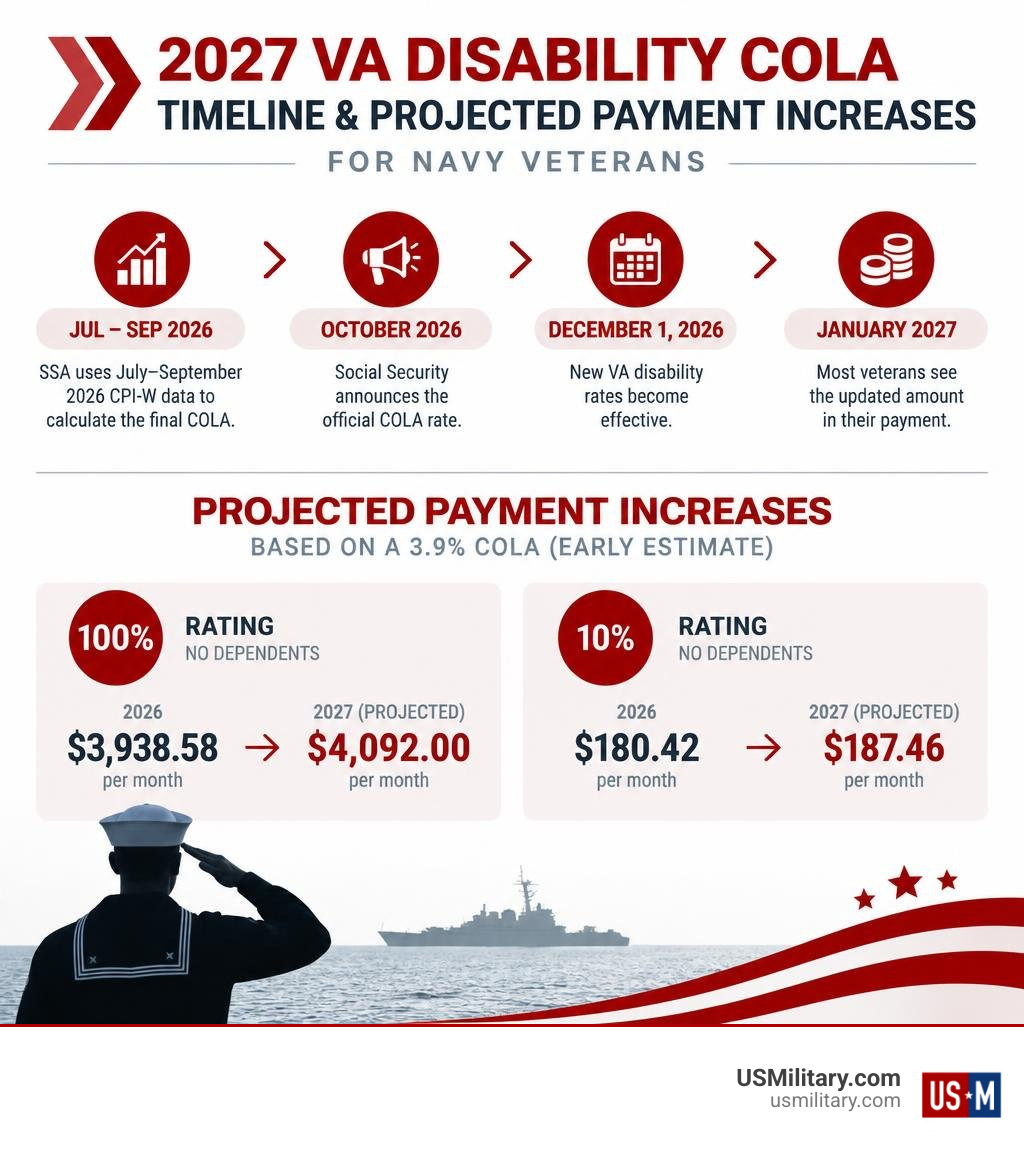
Navy veterans who receive VA disability compensation are expected to get an automatic cost-of-living adjustment (COLA) in 2027. The final rate will not be official until the Social Security Administration announces it in October 2026, but early inflation data supports a projected 3.9% increase.
For 2027 VA Disability Pay Adjustments For Navy Veterans, that estimate would raise a 100% rating with no dependents from $3,938.58 per month in 2026 to about $4,092.00. A 10% rating could rise from $180.42 to about $187.46 per month. You do not need to file a new claim to receive the COLA increase; VA applies it automatically to existing compensation.
Increase Your VA Disability Rating. Get the Disability Pay You Deserve. Free Call With An Expert.
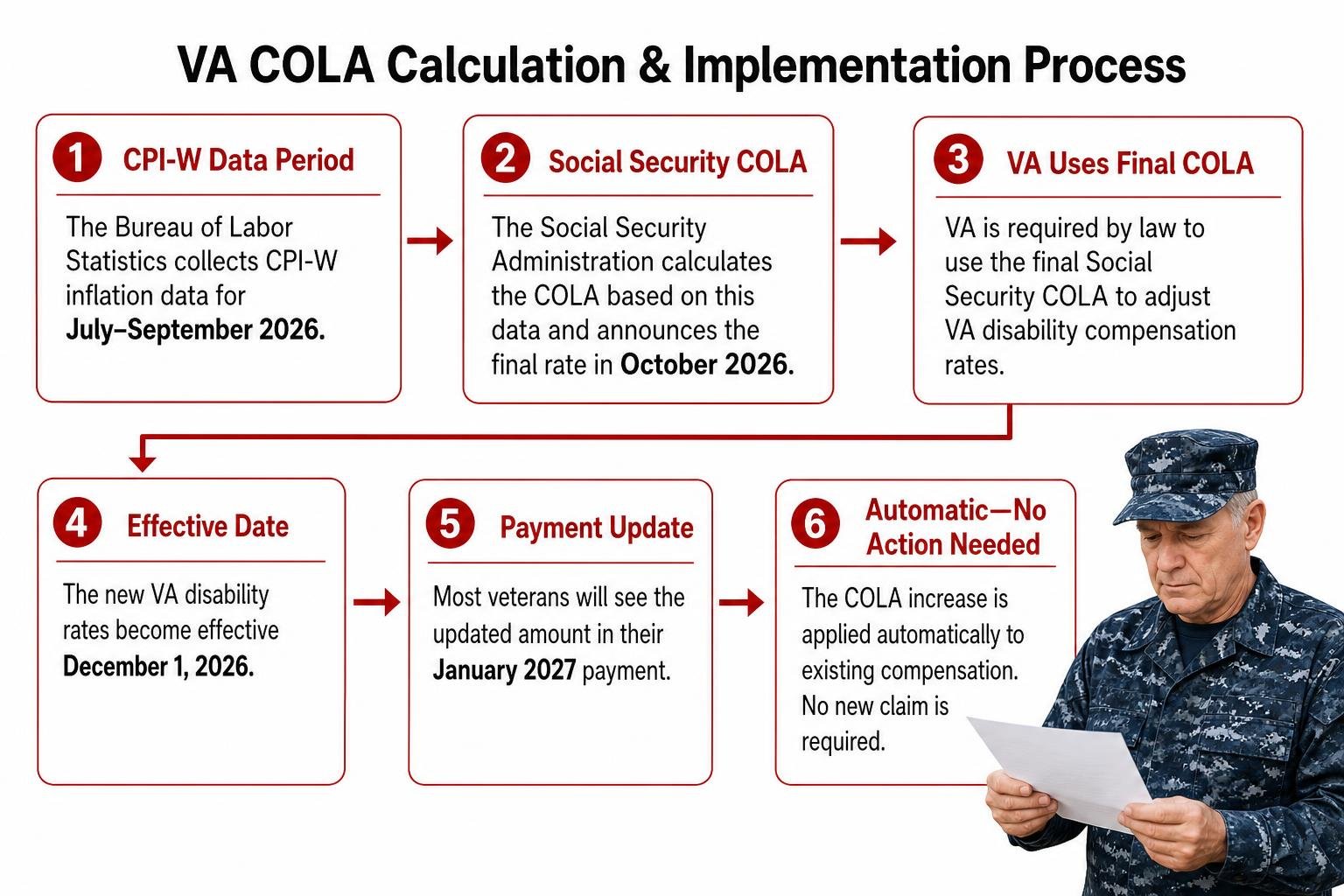
The key dates are simple: VA uses the final Social Security COLA, which is based on July through September 2026 CPI-W inflation data. The new rate becomes effective December 1, 2026, and most veterans should see the updated amount in their January 2027 payment.
I am LARRY FOWLER, publisher of the USNavy.com and the USMilitary.com Network, where I have helped active-duty members and veterans follow VA benefits, Aid and Attendance, and disability compensation trends since 2007. In this guide to 2027 VA Disability Pay Adjustments For Navy Veterans, I will help you separate early projections from official rates and understand what may change in your monthly payment.
Understanding 2027 VA Disability Pay Adjustments For Navy Veterans
Understanding how annual adjustments work is essential for long-term financial readiness. The Department of Veterans Affairs does not set these yearly rate increases arbitrarily. Instead, annual compensation increases are anchored in federal law under 38 U.S.C. Section 1114. By statute, Congress links the annual increase directly to Social Security benefit changes, ensuring veterans retain their purchasing power despite broad economic inflation.
For readers looking into the mechanics behind these increases, understanding VA disability rates and COLA provides a solid foundation of how government indices influence your monthly benefit deposit.
How Economic Forecasts Shape 2027 VA Disability Pay Adjustments For Navy Veterans
The primary metric governing disability adjustments is the Consumer Price Index for Urban Wage Earners and Clerical Workers (CPI-W), compiled monthly by the Bureau of Labor Statistics. When basic consumer items—such as groceries, housing, utilities, and transportation—experience sustained price pressures, the CPI-W reflects that upward trajectory.
Recent estimates released by the Senior Citizens League suggest a projected 3.9% adjustment. This forecast is driven largely by persistent energy costs and gasoline price volatility recorded in early-to-mid 2026. Comparing this to historical cycles demonstrates clear economic momentum:
- 2023: 8.7% (historic inflation spike)
- 2024: 3.2%
- 2025: 2.5%
- 2026: 2.8%
- 2027 (Projected): 3.9%
Reviewing past legislative shifts in our breakdown of 2026 VA disability changes shows how even modest percentage changes accumulate into significant financial support over several fiscal years. While active service compensation follows separate defense spending mandates, VA disability adjustments remain tied to federal inflation metrics.
Key Milestone Dates for the 2027 COLA Announcement
Tracking the implementation schedule helps you plan personal and household budgets accurately:
- July through September 2026: The Bureau of Labor Statistics gathers third-quarter CPI-W numbers.
- Mid-October 2026: The Social Security Administration officially announces the definitive national COLA percentage based on that third-quarter data.
- December 1, 2026: The statutory effective date for updated compensation rates across all rating tiers.
- December 31, 2026 / January 1, 2027: The first direct deposit showing the increased dollar amount arrives in veteran bank accounts (reflecting December entitlement).
For additional historical context on payment timelines, our VA disability pay 2026 guide outlines how these statutory effective dates operate consistently year after year.
Projected 2027 VA Disability Compensation Rates and Pay Breakdown

To help you anticipate your updated monthly baseline, we have projected the 2027 payouts using the leading 3.9% scenario alongside confirmed 2026 figures. You can also explore arithmetic scenario modeling through projected monthly compensation tools.
| Disability Rating | 2026 Monthly Base (No Dependents) | Projected 2027 Monthly Base (3.9% COLA) | Projected Monthly Increase |
|---|---|---|---|
| 10% | $180.42 | $187.46 | +$7.04 |
| 20% | $356.66 | $370.57 | +$13.91 |
| 30% | $552.47 | $574.02 | +$21.55 |
| 40% | $795.84 | $826.88 | +$31.04 |
| 50% | $1,132.90 | $1,177.08 | +$44.18 |
| 60% | $1,435.02 | $1,490.99 | +$55.97 |
| 70% | $1,808.45 | $1,878.98 | +$70.53 |
| 80% | $2,102.15 | $2,184.13 | +$81.98 |
| 90% | $2,362.30 | $2,454.43 | +$92.13 |
| 100% | $3,938.58 | $4,092.19 | +$153.61 |
(Note: Official rates are established following the October 2026 SSA determination; these scenario calculations compound confirmed 2026 rates by 3.9%.)
Impact of 2027 VA Disability Pay Adjustments For Navy Veterans with Dependents
Veterans who have earned a combined service-connected evaluation of 30% or higher are eligible for additional monthly compensation for qualifying dependents, including spouses, minor children, college students under age 23, and dependent parents.
Under projected 2027 rates:
- A veteran rated 100% with a spouse is projected to receive approximately $4,316.18 to $4,320.34 monthly.
- A veteran rated 100% with a spouse and one minor child is projected to receive approximately $4,483.11 per month.
- A veteran rated 70% with a spouse and one child anticipates an estimated monthly benefit of $2,112.50.
When planning family finances, properly evaluating VA disability ratings ensures that all eligible qualifying family members are registered in the VA system to prevent missing out on dependent stipends.
Special Monthly Compensation and the 100% Rating Cliff
Beyond the standard rating schedule, the VA provides Special Monthly Compensation (SMC) for specific severe conditions or functional loss:
- SMC-K: Provides supplemental monthly compensation for the loss of use of a creative organ, extremity, or specific sensory capability.
- Aid and Attendance (A&A): Delivers additional financial allowances for veterans requiring daily personal care and assistance with basic activities of living.
One notable aspect of VA compensation is the “rating cliff” between 90% and 100%. Moving from a 90% evaluation ($2,454.43 projected) to a 100% evaluation ($4,092.19 projected) creates a monthly difference of over $1,637.
Achieving a total rating unlocks substantial ancillary benefits, such as full dental care, CHAMPVA medical coverage for dependents, state-level property tax relief, and complete exemption from federal and state income taxes. Reviewing the complete list of qualifying conditions for veteran disability helps veterans identify if worsening symptoms warrant an increased rating tier.
Strategies for Navy Veterans to Maximize Disability Benefits in 2027

Many Navy veterans live with chronic conditions sustained during their service that have worsened over time. Proactively documenting these conditions can help ensure your disability rating accurately matches your current level of impairment.
Establishing Service Connection for Common Navy Conditions
Shipboard operations, flight deck assignments, and forward deployments present unique environmental and physical demands. Common claims include:
- Acoustic Trauma: High-decibel machinery spaces, engine rooms, and flight decks frequently lead to bilateral hearing loss and tinnitus.
- Musculoskeletal Conditions: Repetitive strain from climbing vertical ladders, heavy lifting in confined spaces, and rough sea operations often cause degenerative disc disease and joint instability.
- Toxic Exposures: Navy personnel exposed to shipboard asbestos, fuels, solvents, or burn pits during Persian Gulf and post-9/11 operations may qualify for expedited presumptive service connections under the PACT Act.
To identify potential secondary conditions—such as radiculopathy resulting from a service-connected back injury—consult our comprehensive VA disability conditions list.
Gathering Medical Evidence and Disability Benefits Questionnaires (DBQs)
Submitting a well-documented claim significantly improves adjudication timelines and accuracy:
- Nexus Letters: Obtain formal medical opinions connecting current chronic diagnoses to documented in-service events or injuries.
- Disability Benefits Questionnaires (DBQs): Have private physicians complete official DBQs detailing the functional limitations of your conditions.
- Compensation & Pension (C&P) Exams: Review your medical history thoroughly prior to your appointment and describe your symptoms on your worst days.
Understanding fundamental VA disability benefits eligibility gives you the tools needed to present clean, persuasive medical evidence.
Frequently Asked Questions About 2027 VA Disability Compensation
Will Navy veterans need to apply manually to receive the 2027 COLA increase?
No. VA disability adjustments are fully automated by federal mandate. Once the final percentage is established in October 2026, the VA updates its master payment schedules. The revised amount will automatically appear in your direct deposit on the first business day of January 2027 without any paperwork or claims required on your part.
Are 2027 VA disability payments subject to federal or state income taxes?
No. VA disability compensation payments are 100% tax-exempt at both the federal and state levels. They do not count toward your gross taxable income on IRS Form 1040. Furthermore, receiving non-taxable VA compensation does not negatively impact eligibility for military retired pay under Concurrent Retirement and Disability Pay (CRDP) rules for eligible 20-year retirees rated at 50% or higher.
How do dependents affect monthly compensation at lower disability ratings?
The VA only adds dependent allowances for veterans with a combined disability rating of 30% or higher. If you are rated at 10% or 20%, you receive a flat monthly rate regardless of whether you are married or have dependent children. If your service-connected conditions worsen and push your combined rating to 30% or above, you should immediately submit VA Form 21-686c to add your eligible dependents.
Conclusion
The projected 3.9% adjustment for 2027 represents meaningful financial reinforcement for Navy veterans managing service-connected health conditions. By keeping track of official announcements each autumn, monitoring your rating accuracy, and ensuring all qualifying dependents are registered, you can make sure your household receives every dollar earned through your military service.
We encourage you to access the updated VA disability pay tables on USMilitary.com as official figures are finalized, and explore our full range of benefits calculators to support your financial planning.