
Why Choose the Navy Over Other Military Branches?

Join the Navy over other branches if you want global travel, advanced technical work, and a career tied to aviation or life at sea. The Navy is a strong fit for people who want to work on ships, submarines, aircraft, cyber systems, intelligence, or nuclear propulsion – and who can accept longer time away from home.
Compared with the other services, the Navy stands out for:
- Worldwide missions: Sailors operate across the oceans and may visit ports in Europe, Asia, Africa, and beyond.
- Technical career choices: The Navy has more than 80 ratings, including nuclear power, aviation maintenance, cyber, intelligence, and engineering.
- One-of-a-kind aviation: Navy pilots can launch from and land on aircraft carriers, an experience the Air Force does not offer.
- Competitive incentives: High-demand programs can offer large enlistment bonuses, though eligibility and amounts change often.
- Coastal duty stations: Many Navy installations are near major coastal cities and ports.
The tradeoff is real: Navy deployments often run about six to nine months, shipboard living is tight, and schedules can change quickly. If your top priority is steady family time and predictable base life, the Air Force, Space Force, or Coast Guard may fit better. But if you want a bigger technical community, maritime missions, and more chances to see the world, the Navy offers a path few other branches can match.
I am LARRY FOWLER, publisher of the USMilitary.com Network since 2007, where we help future service members and veterans navigate military careers, benefits, and service decisions. In answering Why Should I Join The Navy Over The Other Military Branches?, I focus on the practical details that matter most: job options, deployments, financial benefits, and life after service.
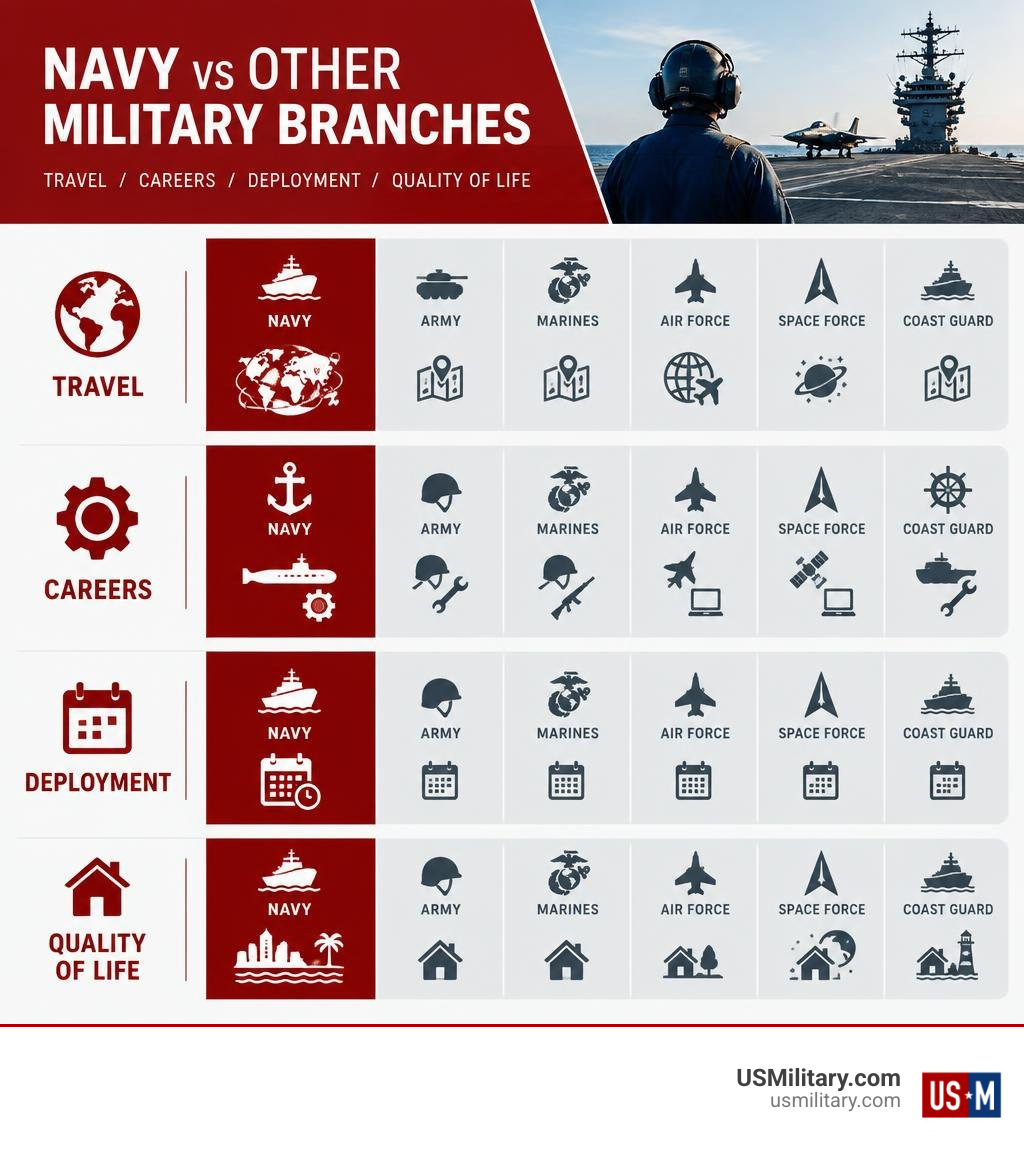
Why Should I Join The Navy Over The Other Military Branches?
When deciding which uniform to wear, prospective recruits often ask how service life differs across branches. Deciding where to serve requires looking at daily culture, core missions, and global presence. With roughly 353,820 active-duty sailors and 58,000 reserve personnel, the Navy operates a massive maritime enterprise. The fleet maintains approximately 300 battle-force vessels operating across every major ocean, giving sailors unmatched reach.
If you are exploring your options, understanding why you should care about Navy jobs starts with recognizing how distinct the maritime mission is compared to land-based branches. While the Army and Marine Corps specialize in ground combat and expeditionary maneuver warfare, the Navy projects power across international waters, protects global shipping lanes, and delivers high-tech defense capabilities from the sea.
Global Travel and International Port Visits
No other branch can match the sheer geographic distance logged by naval vessels. The Navy’s fleet travels more than 2.5 million miles every year—enough to circle the globe 100 times over.
While soldiers or airmen might spend an entire deployment stationed at a single overseas base, sailors on a deployment routinely visit multiple countries. A single 6- to 9-month deployment can include port visits throughout Europe, Asia, the Middle East, Africa, and South America. For instance, pulling into vibrant ports like Singapore, Naples, or Yokosuka gives sailors the chance to experience diverse cultures during authorized port liberty. If seeing the world through your own eyes rather than a screen is your primary goal, the Navy delivers that reality.
High-Tech Ratings and Nuclear Power Specializations
The Navy offers more than 80 distinct enlisted job fields, known as “ratings.” This provides vastly more specialization than smaller maritime services like the Coast Guard, which has around 25 ratings.
Navy ratings focus heavily on cutting-edge engineering, advanced electronics, cryptography, and information warfare. For individuals seeking six-figure military career paths that transition directly to high-paying civilian sectors, the Navy’s Nuclear Propulsion Program stands out. Operating nuclear reactors on submarines and aircraft carriers provides hands-on engineering experience that civilian power companies and defense contractors actively recruit.
Naval Aviation vs. Air Force Flight Opportunities
Both the Navy and the Air Force produce elite pilots, but their operational environments and flight profiles are entirely different. Deciding between the two often comes down to the kind of flying you want to do and where you want your home base to be.
Carrier Operations and Tactical Flight Training
The defining mark of a Naval Aviator is the aircraft carrier. Landing a high-performance jet on a pitching flight deck in rough seas at night requires extraordinary precision. Navy pilots master catapult-assisted takeoffs and arrested tailhook recoveries—skills unique to naval aviation that land-based Air Force pilots do not experience.
Air Force flight pipelines through Air Force ROTC or the Air Force Academy offer access to a large fleet of land-based fighters, bombers, and cargo aircraft with predictable runway environments. In contrast, Navy pilots train through NROTC or Officer Candidate School (OCS) to operate in expeditionary maritime conditions where the flight deck moves constantly underneath them.
Why Should I Join The Navy Over The Other Military Branches for Aviation Careers?
Beyond the thrill of carrier aviation, Navy flight squadrons foster a tight-knit wardroom culture built around maritime missions. Navy pilots fly tactical fighters like the F/A-18 Super Hornet and F-35C Lightning II, as well as maritime patrol platforms like the P-8 Poseidon and MH-60 Seahawk helicopters. Because naval air wings deploy alongside the ship’s crew, aviators experience international port calls together with the broader surface fleet, blending tactical aviation with global adventure.
Compensation, Enlistment Bonuses, and Educational Benefits
Military base pay is standardized by Congress across all branches based on rank and time in service. However, enlistment incentives and educational bonuses vary significantly by branch needs.
The table below outlines how compensation, entry incentives, and job diversity stack up across branches in 2026:
| Military Branch | Maximum Enlistment Bonus | Number of Career Fields | Typical Deployment Length | Primary Duty Focus |
|---|---|---|---|---|
| U.S. Navy | Up to $140,000 (stacked) | 80+ ratings | 6–9 months | Maritime, Aviation, Nuclear & Cyber |
| U.S. Air Force | Up to $50,000 | 130+ AFSCs | 4–6 months | Air, Space & Cyber Defense |
| U.S. Army | Up to $50,000 | 150+ MOSs | 6–9 months | Ground Combat & Land Operations |
| U.S. Marine Corps | Up to $40,000 | 120+ MOSs | 6–7 months | Expeditionary & Amphibious Assault |
| U.S. Coast Guard | Up to $75,000 | 25+ ratings | 2–3 months | Maritime Safety & Law Enforcement |
| U.S. Space Force | Up to $40,000 | ~15 specialties | Minimal (Stationary) | Orbital Warfare & Satellite Defense |
For a complete breakdown of base pay rates, allowances, and special pays, check our guide on how much active duty service members earn in 2026.
Top Enlistment Bonuses in High-Demand Fields
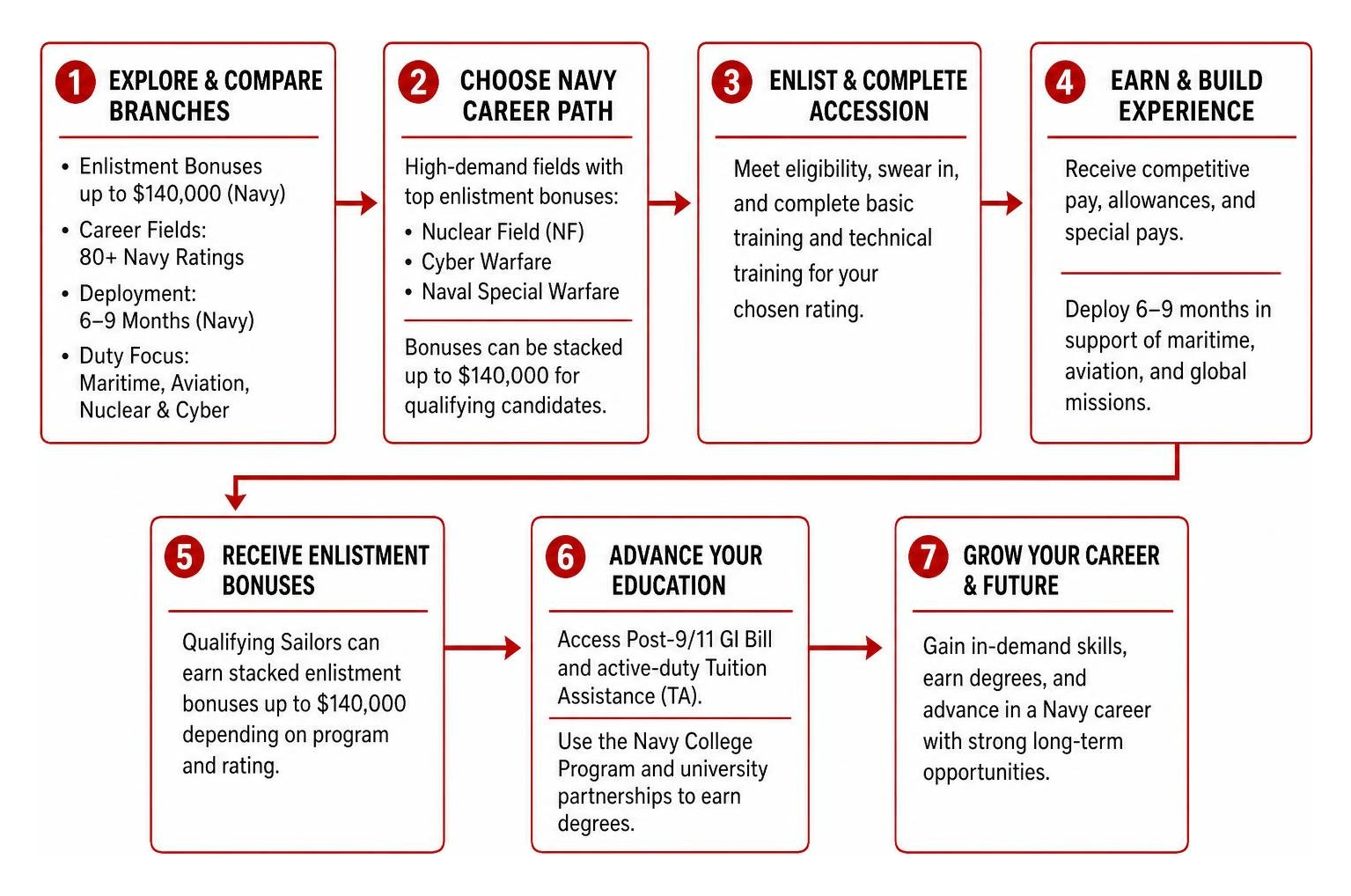
To staff critical technical ratings, the Navy offers stacked enlistment bonuses reaching up to $140,000 for qualifying candidates who enter programs like Nuclear Field (NF), Cyber Warfare, and Naval Special Warfare. This cap is significantly higher than the Coast Guard’s maximum bonus of $75,000 or the Air Force’s standard incentives.
Post-9/11 GI Bill and Navy College Fund Programs
Every branch provides access to the federal Post-9/11 GI Bill and active-duty Tuition Assistance (TA). However, the Navy complements these benefits with the Navy College Program and partnerships with accredited universities. Sailors can earn fully funded associate and bachelor’s degrees during shore duty or off-duty hours. You can compare degree acceleration options in our review of the best military branches for higher education.
Navy Quality of Life, Sea-Shore Flow, and Branch Culture
Daily life in the Navy is structured around alternating periods of operational sea duty and stateside shore duty. Understanding this cycle helps you plan personal and professional milestones.
Before enlisting, applicants must meet specific baseline standards; review the complete overview of Navy entry requirements to verify your eligibility.
Sea Duty vs. Shore Duty Rotation Cycles
The Navy manages workload and career progression through its Sea-Shore Flow policy. Tour lengths are determined by your specific rating rather than rank alone. A typical cycle includes:
- Sea Tour (36–48 months): Assigned to a ship, submarine, or operational squadron. While the vessel is homeported, sailors work standard weekdays, heading out to sea for training exercises and scheduled 6- to 9-month deployments.
- Shore Tour (24–36 months): Assigned to a naval station, training facility, or recruiting command. Deployments are paused, providing predictable daily hours, regular family routines, and expanded time for college coursework.
Why Should I Join The Navy Over The Other Military Branches for Work-Life Balance?
While the Air Force is widely recognized for superior on-base housing and the Coast Guard for shorter deployments, the Navy provides an exceptional coastal lifestyle. Major Navy fleet concentrations are situated in desirable coastal metropolitan regions:
- San Diego, California: Naval Base San Diego and NAS North Island offer year-round sunshine, beaches, and top-tier family recreational facilities.
- Norfolk / Virginia Beach, Virginia: Naval Station Norfolk provides expansive military community infrastructure, low cost of living, and waterfront living.
- Pacific Northwest: Bases like Naval Station Everett and NAS Whidbey Island in Washington offer outdoor recreation and modern base amenities.
- Overseas Bases: Locations like Yokosuka (Japan), Rota (Spain), and Naples (Italy) give sailors and their families overseas living experiences.
Frequently Asked Questions about Navy Enlistment
Which military branch promotes enlisted personnel the fastest?
The U.S. Army generally provides the fastest path to junior and mid-grade enlisted ranks (E-4 to E-6) due to its larger troop size and semi-centralized promotion point system.
In the Navy, advancement from E-4 to E-7 relies on the Navy-Wide Advancement Exam (NWAE), evaluations, and “rating quotas.” If you enter a high-demand, under-manned technical field (such as nuclear power, advanced electronics, or cryptology), Navy promotions can move rapidly. Conversely, over-manned ratings may experience slower advancement cycles.
How does Navy boot camp compare to other military basic training?
Navy Recruit Training Command (RTC) at Great Lakes, Illinois, lasts approximately 9 weeks. It focuses on seamanship, firefighting, damage control, water survival, and physical fitness.
In comparison:
- Marine Corps: 13 weeks (most physically demanding)
- Army: 10 weeks (focused on field combat tactics)
- Air Force & Space Force: 8.5 weeks (focused on aerospace principles and base operations)
- Coast Guard: 8 weeks (aquatic and law-enforcement focused)
The Navy is also efficient at processing medical waivers (averaging 5 to 6 days compared to over 80 days for the Army or Air Force). If you are preparing to enlist, read our walk-through on joining the armed forces to understand every stage of the MEPS pipeline.
Is the Navy harder to get into than the Coast Guard?
Generally, the Coast Guard is more competitive to join than the Navy. The Coast Guard operates as a much smaller force (about 41,000 active members vs. the Navy’s 353,000+), meaning fewer recruiting slots open up each fiscal year.
Additionally, the Coast Guard requires a minimum Armed Forces Qualification Test (AFQT) score of 32 on the ASVAB, whereas the Navy’s minimum standard is 31. The Navy also provides a wider range of enlistment waivers and preparatory academic programs for qualified candidates.
Conclusion
Choosing the right military branch comes down to matching your personal priorities with each service’s core mission. If your goal is staying close to home with minimal operational disruptions, services like the Space Force or Coast Guard may suit your preferences.
However, if you want real-world global travel, unmatched technical credentials, lucrative enlistment incentives, and the opportunity to serve at sea or in naval aviation, the Navy stands apart.
At USMilitary.com, we provide unbiased resources, VA loan information, and career guidance across every branch of the Armed Forces. Explore our comprehensive guide to branches of the military to compare all your options and take the next step in your military journey.