
What the Navy Pay Chart 2027 Could Mean for Your Pay

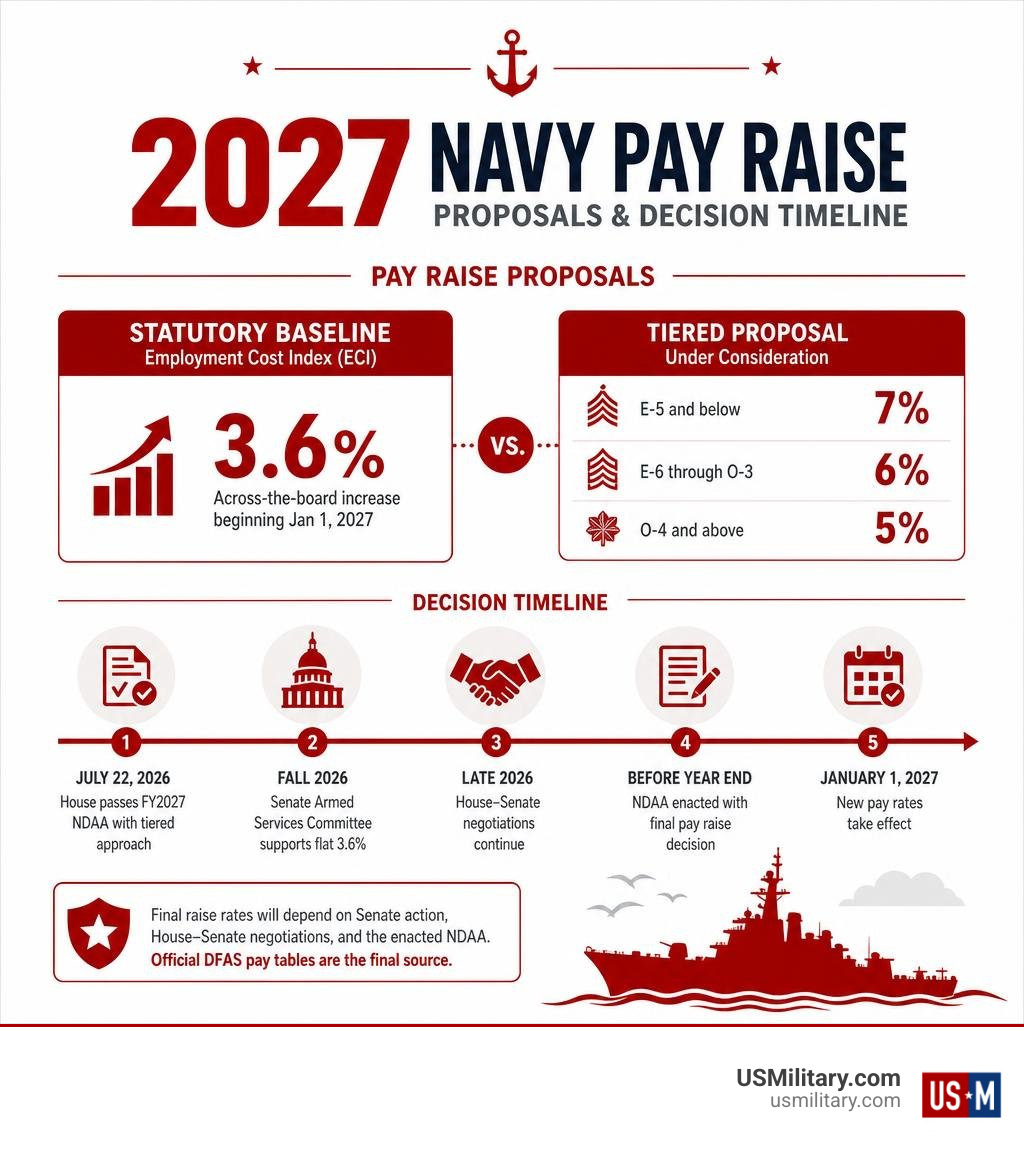
The Navy Pay Chart 2027 is not final yet. As of September 2026, Sailors should budget around a 3.6% basic-pay increase beginning January 1, 2027. That is the statutory raise based on the Employment Cost Index.
Congress is also weighing a larger tiered plan:
- 7% for E-5 and below
- 6% for E-6 through O-3
- 5% for O-4 and above
The House passed a version of the FY2027 NDAA with the tiered approach on July 22, 2026. The Senate Armed Services Committee instead supports the flat 3.6% increase. Final rates will depend on Senate action, House-Senate negotiations, and the enacted NDAA. Official DFAS pay tables should be the final source for every rank and years-of-service amount.
Increase Your VA Disability Pay! Talk With An Expert About Increasing Your VA Disability Rating With A Free Call Here!
The raise applies to basic pay, including active-duty and Reserve drill-pay tables. It does not automatically set BAH, BAS, clothing allowances, aviation incentive pay, or other special pays. Those parts of Navy compensation are reviewed under separate rules and schedules.
I am Larry Fowler, publisher of the USMilitary.com Network since 2007, where I have helped active-duty members, recruits, and veterans understand military benefits and pay trends. In this Navy Pay Chart 2027 guide, I will break down the proposed rates, drill-pay estimates, and the steps still needed before final figures are published.
Proposed Navy Pay Chart 2027 for Enlisted Sailors and Officers

Calculating your future earnings requires balancing the statutory baseline against the executive branch’s targeted proposals. To plan your household budget for the upcoming calendar year, check out our Early Look 2027 Military Pay Chart Guide alongside the official Military Pay Tables & Information published by the Defense Finance and Accounting Service (DFAS).
The following estimated monthly basic pay figures reflect both the statutory 3.6% baseline and the tiered 5% to 7% proposal across key active-duty pay grades and experience levels:
| Pay Grade & Experience | 2026 Active Duty Base Pay | 2027 Projected (Flat 3.6%) | 2027 Projected (Tiered 5-7%) |
|---|---|---|---|
| E-1 (< 4 months) | $2,017.20 | $2,089.82 | $2,158.40 (7%) |
| E-2 (> 2 years) | $2,319.00 | $2,402.48 | $2,481.33 (7%) |
| E-3 (> 3 years) | $2,642.10 | $2,737.22 | $2,827.05 (7%) |
| E-4 (> 4 years) | $3,371.10 | $3,492.46 | $3,607.08 (7%) |
| E-5 (> 6 years) | $3,878.40 | $4,018.02 | $4,149.89 (7%) |
| E-6 (> 10 years) | $4,582.50 | $4,747.47 | $4,857.45 (6%) |
| E-7 (> 16 years) | $5,612.40 | $5,814.45 | $5,949.14 (6%) |
| E-8 (> 20 years) | $6,639.30 | $6,878.31 | $7,037.66 (6%) |
| E-9 (> 24 years) | $8,298.60 | $8,597.35 | $8,796.52 (6%) |
| W-2 (> 6 years) | $5,310.60 | $5,501.78 | $5,629.24 (6%) |
| W-4 (> 16 years) | $7,842.00 | $8,124.31 | $8,312.52 (6%) |
| O-1 (< 2 years) | $3,826.20 | $3,963.94 | $4,055.77 (6%) |
| O-2 (> 3 years) | $5,178.60 | $5,365.03 | $5,489.32 (6%) |
| O-3 (> 6 years) | $7,131.90 | $7,388.65 | $7,559.81 (6%) |
| O-4 (> 12 years) | $9,418.80 | $9,757.88 | $9,889.74 (5%) |
| O-5 (> 20 years) | $11,402.10 | $11,812.58 | $11,972.21 (5%) |
| O-6 (> 22 years) | $13,638.30 | $14,129.28 | $14,320.22 (5%) |
| O-7 (> 26 years) | $15,939.60 | $16,513.43 | $16,736.58 (5%) |
| O-8 (> 28 years) | $17,984.70 | $18,632.15 | $18,883.94 (5%) |
| O-9 (> 30 years) | $19,305.90 | $20,000.91 | $20,271.20 (5%) |
| O-10 (> 30 years)* | $19,305.90 | $20,000.91 | $20,271.20 (5%) |
Note: Executive Schedule statutory caps apply to flag officers (Level II for O-7 through O-10 and Level V for O-6 and below).
Understanding the Active Duty Navy Pay Chart 2027 Projections
Every Sailor’s pay trajectory is guided by two factors: pay grade and cumulative time in service. As an enlisted service member climbs from Seaman Recruit to Master Chief Petty Officer, pay increments trigger at regular two-year thresholds. Exploring From E 1 To O 4 A Deep Dive Into Active Duty Military Pay And Benefits provides clear insight into how promotion milestones dramatically shift your base pay.
For newly enlisted personnel trying to chart out their multi-year career path, reviewing our Beginners Guide To Estimated Military Pay Chart For 2027 ensures that you factor in standard longevity steps. In the military pay system, longevity step increases combine with annual cost-of-living pay raises, meaning your paycheck frequently grows faster than the baseline percentage debated by Congress.
Navy Pay Chart 2027 Drill Rates for Selected Reserve Personnel
Members of the Navy Reserve earn compensation using a statutory daily calculation: exactly 1/30th of the active-duty basic pay rate for their specific pay grade and years of service for each four-hour drill period. A standard drill weekend contains four individual drill periods (two Multiple Inactive Duty Training drills per day), equating to four days’ worth of active basic pay.
Under the baseline 3.6% statutory raise for 2027:
- A Petty Officer Second Class (E-5) with over 4 years of service earns approximately $136.25 per drill, totaling $545.00 for a four-drill weekend.
- A Chief Petty Officer (E-7) with over 6 years of service receives $167.25 per drill, totaling $669.00 per weekend.
- A Lieutenant (O-3) with over 12 years of service earns $303.50 per drill, yielding $1,214.00 per weekend.
- A Captain (O-6) with over 16 years of service earns $543.50 per drill, delivering $2,174.00 across four drill periods.
When reservists perform their mandatory two weeks of Annual Training (AT) or deploy on active-duty operational support orders, they transition directly to the standard active-duty daily pay rate.
House vs. Senate: The Competing 2027 Military Pay Raise Proposals

The debate surrounding the FY2027 National Defense Authorization Act highlights divergent views on total force compensation. On July 22, 2026, the House passed H.R. 8800, authorizing the tiered 5% to 7% military raise designed to combat inflation and bolster junior enlisted recruiting. Our ongoing coverage of Marching Toward Fairer Pay With Military Pay Equity In 2026 examines how targeted raises help narrow the income disparity for early-career military personnel.
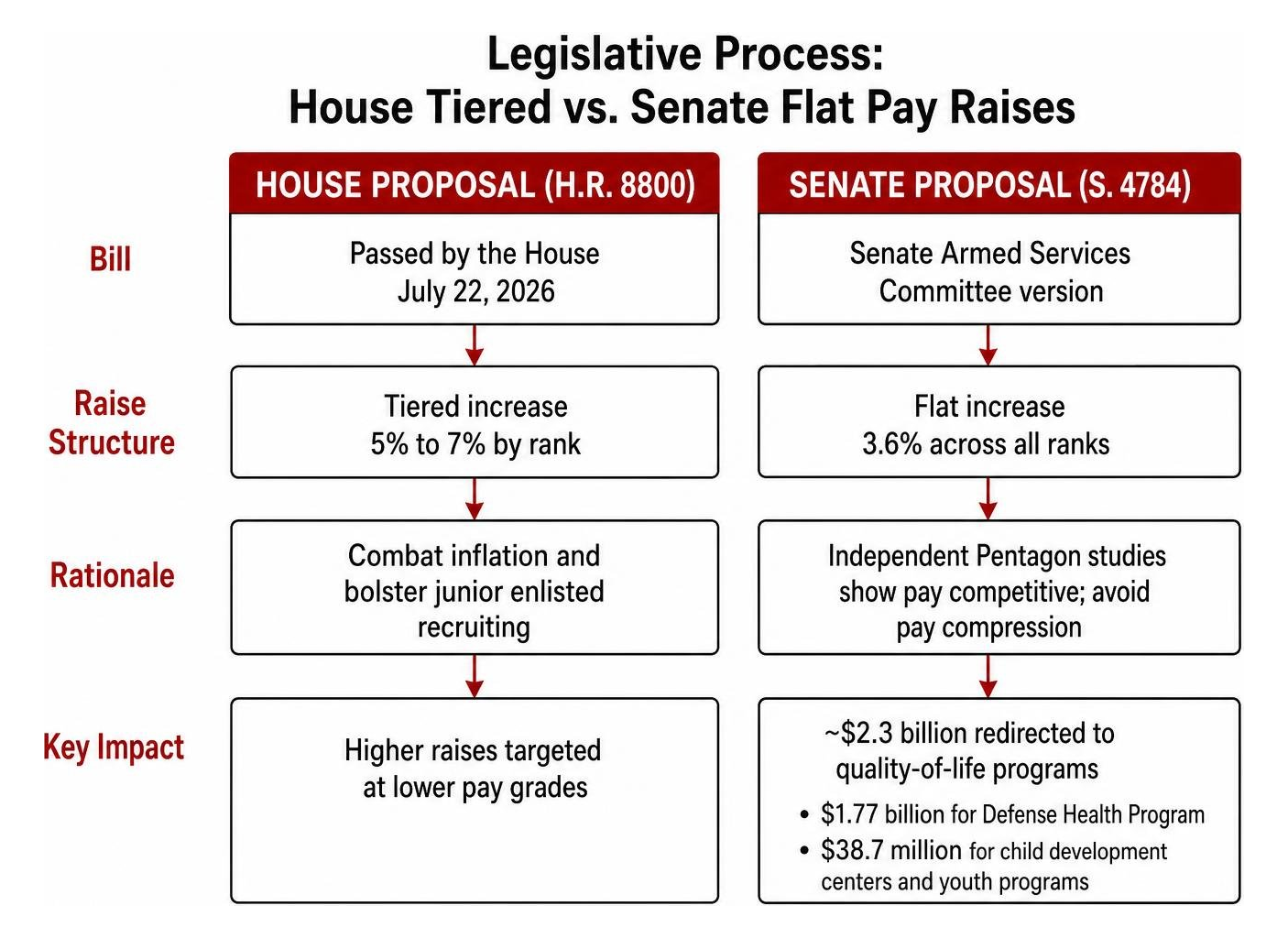
In contrast, the Senate Armed Services Committee’s version (S. 4784) adheres strictly to the 3.6% flat increase across all ranks. Senate leaders pointed to independent Pentagon compensation studies showing junior enlisted pay already competes well against civilian percentiles. They raised valid concerns regarding pay compression—where disproportionate raises for lower pay grades shrink the financial incentive for sailors to take on higher supervisory ranks.
By adopting the flat 3.6% increase, the Senate proposal redirects approximately $2.3 billion into quality-of-life programs:
- $1.77 billion dedicated to the Defense Health Program to address medical staffing and clinic access.
- $38.7 million injected directly into military child development centers and youth programs.
- Additional targeted funding reserved for specialized bonuses and hazardous duty incentive pays.
Because H.R. 8800 funded the tiered raise within its authorization tables without formally amending 37 U.S.C. § 1009, House and Senate conferees must resolve these spending priorities before a final compromised NDAA reaches the President’s desk.
ECI Calculation, Allowances, and Historical Context
Military basic pay raises default automatically according to 37 U.S.C. § 1009, which ties the baseline percentage to the Department of Labor’s Employment Cost Index (ECI). Specifically, the statutory formula measures the wage growth of private-sector workers from the third quarter of the third preceding year to the third quarter of the second preceding year. For calendar year 2027, this calculated economic benchmark landed at exactly 3.6%.
Understanding total compensation requires looking beyond basic pay. To see how your total military package operates, review our detailed guide on How Much You Will Earn On Active Duty In 2026.
Allowances follow separate adjustment rules:
- Basic Allowance for Housing (BAH) is calculated annually using localized housing and utility rental market surveys across nearly 300 Military Housing Areas.
- Basic Allowance for Subsistence (BAS) adjusts annually based on the Department of Agriculture food cost index published every autumn.
- Special and Incentive Pays, including Aviation Incentive Pay, Submarine Duty Pay, and Sea Duty Incentive Pay, are governed by independent statutory caps and Navy service administrative instructions.
| Year | Approved Basic Pay Increase | Economic Context |
|---|---|---|
| 2023 | 4.6% | Post-pandemic inflation response |
| 2024 | 5.2% | Highest across-the-board raise in two decades |
| 2025 | 4.5% (with junior enlisted structural boost) | Focus on lower-enlisted quality of life |
| 2026 | 3.8% | Transition back to ECI wage tracking |
| 2027 (Est.) | 3.6% (Statutory) or 5–7% (Tiered) | Pending House-Senate NDAA conference |
Over the past 5 years, military pay increases averaged 4.2%, while the 10-year rolling average sits at 3.4%. The statutory 3.6% for 2027 continues this pattern of competitive wage tracking.
Frequently Asked Questions About the 2027 Navy Pay Scale
When will the final 2027 Navy pay raise take effect?
The finalized military pay raise officially takes effect on January 1, 2027. Active-duty Sailors and Navy Reservists will see these adjustments reflected in their mid-month January Leave and Earnings Statement (LES), with payment distributed on the standard January 15 mid-month payday.
Does the 2027 basic pay increase automatically adjust BAH and BAS?
No. Basic Allowance for Housing (BAH) and Basic Allowance for Subsistence (BAS) do not move in tandem with basic pay percentages. The Department of Defense establishes housing allowance adjustments in mid-December using commercial rental data, while BAS rates update based on the USDA food index.
Will Navy veterans and military retirees receive this pay raise?
Military retirees and disabled veterans do not receive the active-duty basic pay raise. Instead, military retirement pay and VA disability compensation adjust annually via the federal Cost-of-Living Adjustment (COLA), which is derived from the Consumer Price Index for Urban Wage Earners and Clerical Workers (CPI-W) and announced each October.
Conclusion
Understanding the moving pieces of the upcoming pay raise enables Sailors and military families to plan their financial futures with clarity. While Congress reconciles the difference between the statutory 3.6% baseline and the targeted 5% to 7% tiered proposal, budgeting around the 3.6% baseline ensures your savings goals remain firmly on track.
Explore our complete suite of military pay chart resources at USMilitary.com for ongoing coverage of the FY2027 NDAA, career guidance, and military benefits updates.

Need More Confidence? Courage? Check out Dare To Live Greatly, a book about comparing Navy SEAL training and courageous faith through trials, life, and hard times.